
Wall Street-correlated stock markets are facing the risk of correction, as Christopher Wood, the global head of equity strategy at Jefferies, conveys to investors in his latest edition of GREED & fear. Rising crude oil prices, which are nearing $100 a barrel (Brent), pose a threat to the global central bank's battle against inflation and have led to a re-evaluation of its exposure to Indian stocks. "The potential for more US Federal Reserve (Fed) rate hikes, combined with the risk that monetary tightening finally bites as regards the economy, remains a risk for Wall Street-correlated world stock markets. "There is also the oil factor. This is why GREED & fear continues to believe the pain trade is down. "Areas in Asia, such as Indian midcaps, which have already done very well, are at obvious risk of some profit-taking," writes Wood.

Only experienced investors with a high risk appetite, a grasp of market cycles, and comfort with volatility and timing risk should invest.

'Given the worries about sluggish growth, rising interest rates and likely volatility, it's quite logical to infer that the SIP route could be the preferred way of investing.'

Trump couldn't care less anymore about the Israeli demand for Iran's 'de-nuclearisation' and 'de-militarisation.' Trump pins hopes on a grand bargain with Iran as a partner in America First, argues Ambassador M K Bhadrakumar.
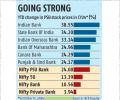
Stock Market News today, PSU banks: The year 2024 was a roller-coaster ride for Indian stock markets, marked by volatility driven by the Lok Sabha elections, Union Budget 2024, a slowdown in corporate earnings, and sticky inflation. Geopolitical tensions - particularly between Israel and Iran in West Asia - along with various stimulus announcements by China and yen carry trade rocked the equity markets throughout the year.

Investors' wealth climbed Rs 3.20 lakh crore as markets staged a smart comeback on Wednesday after falling in the last eight trading sessions. The BSE Sensex rallied 448.96 points or 0.76 per cent to settle at 59,411.08. During the day, it jumped 513.33 points or 0.87 per cent to 59,475.45.

Dalal Street minnows stole the show in 2024, giving handsome returns to investors, helped by a largely optimistic trend in the stock market and impressive retail investors' participation. Analysts attributed the positive trend in the equity markets, where the benchmark indices shattered many records this year, to robust domestic liquidity, strong fundamentals of the Indian economy, and policy continuity.

IndusInd Bank was the top gainer in the Sensex pack, zooming around 8 per cent, followed by PowerGrid, Dr Reddy's, Sun Pharma, NTPC and Axis Bank. On the other hand, UltraTech Cement, Maruti, ITC, Kotak Bank and Asian Paints were among the losers.

Foreign investors continue to pull back money from the Indian equity market, withdrawing Rs 24,753 crore (about $2.8 billion) in the first week of March amid escalating global trade tensions and lacklustre corporate earnings.

'The market should maintain optimism on the back of range-bound oil prices, a robust fiscal balance sheet, a better-than-expected monsoon, and moderating inflation.'

Historically, March has been a volatile month for Indian equity markets. To begin with, it marks the end of a financial year, wherein there is some compulsive portfolio rebalancing trade by large funds - domestic and foreign. Retail investors, too, prefer to 'cash in' on their gains and losses before the financial year runs out.

'I don't see 88 per dollar now.'

Indian stock markets are expected to be driven mostly by global factors this week amid a lack of local triggers and earnings season largely coming to an end, say analysts. Crude oil prices, rupee movement and US Federal Reserve meeting minutes to be released this week will also influence the market sentiment. "With the earnings season behind us, global cues would largely dictate the trend in the coming week," Ajit Mishra, SVP - technical research, Religare Broking Ltd, said.

'If you look at where inflation (headline and core) is today in India and where the rates are, there's clearly room to cut rates.'

Automobile giant Tata Motors' shares were in demand on Wednesday as the stock rallied as much as 3.69 per cent to hit an intraday high of Rs 671.80 per share, before settling 3.18 per cent higher at Rs 668.45. By comparison, the BSE Sensex settled 0.10 per cent, or 72.56 points, lower at 74,029.76.

Benchmark indices--Sensex and Nifty--were 0.7-0.8 per cent higher from the Saturday closing. Among the widely-tracked Nifty 50 stocks, 39 advanced and the rest 11 declined at the opening bell. Among the individual stocks, Cipla, ICICI Bank, Sun Pharma, Power Grid Corp, and Bharti Airtel were the top five gainers, while Asian Paints, Hindustan Unilever, Britania, HDFC Bank, and BPCL the losers, NSE data showed. On Monday, Indian stock exchanges were closed for trading on the occasion of Pran Pratistha of Ram Temple in Ayodhya.

Mahindra and Mahindra was the top gainer in the Sensex pack, surging over 16 per cent, followed by Maruti, Titan, Bajaj Finance, HDFC, Bajaj Auto and Hero MotoCorp. On the other hand, HUL, Tech Mahindra, IndusInd Bank and Nestle were the laggards.

'This resilience should be viewed as reflecting the strength of the structural story.'

'Some risks to this market rally include inflation, erratic weather conditions, rising crude prices, slowing global growth and the resultant impact on domestic exports, escalation in geopolitical tensions.'

Despite volume growth in the export segment and strong demand in the domestic market, pricing uptick is eluding Indian agrochemical companies.

Nestle, State Bank of India, Power Grid, Tata Steel, Larsen & Toubro and Mahindra & Mahindra were the other major gainers. In contrast, Tech Mahindra, Axis Bank and Reliance Industries were the laggards.

'Investors looking at the next 6-12 months can be certain that the Fed will maintain its easing cycle, and we expect the overall environment to be conducive for fixed income investments for portfolio diversification.'

Sun Pharma, Bajaj Finserv, Tata Consultancy Services, Infosys, Hindustan Unilever, JSW Steel, Wipro, Maruti, HCL Technologies, Tech Mahindra and ICICI Bank were the other major gainers. State Bank of India, Tata Motors, Axis Bank, Kotak Mahindra Bank, Bajaj Finance, Tata Steel, Nestle and HDFC Bank were the laggards.

The trigger for international gold prices rising to $3,000 per ounce was Germany's upcoming heavy government borrowing.

'Such big falls are quite frequent these days, so do not try to time this market.' 'Use big dips to accumulate quality stocks.'

From the Sensex basket, Larsen & Toubro, Bajaj Finance, Axis Bank, State Bank of India, UltraTech Cement, Wipro, ICICI Bank, Infosys, HCL Technologies and Asian Paints were the major gainers. NTPC, JSW Steel and HDFC Bank were the laggards.

The recent price correction in broader markets has hit cement companies hard. So far in the current month, smallcap firms like Visaka Industries, Andhra Cements NCL Industries, Sahyadri Industries, and KCP have lost 19.7 per cent, 14.3 per cent, 13.8 per cent, 13.5 per cent, and 11.5 per cent, respectively. On the contrary, largecap companies, while registering losses for the month, have seen a softer blow.

If a 5% to 10% fall in the equity market gives you sleepless nights, you are not cut out for a 75% to 80% allocation to equities and must reduce it.

Among the 30 Sensex companies, Larsen & Toubro, Power Grid, NTPC, State Bank of India, Reliance Industries and HDFC Bank were the biggest laggards. Sun Pharma and Nestle were the only gainers.
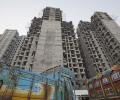
Shares of real estate firms have been outperforming over the past year. The rally, analysts say, may hit roadblocks in the near term amid stretched valuations, even as the long-term prospects for the sector remain ebullient. "Most of the positive news flow is already in the price. Hence, investors sitting on hefty profits may partially cash out at current levels," suggests V K Vijayakumar, chief investment strategist at Geojit Financial Services.

Domestic equity investors' wealth eroded by more than Rs 4.43 lakh crore on Monday as fears of a financial contagion triggered by one of the biggest bank failures in the US roiled market sentiments. After a strong opening, Indian stocks went into a tailspin with the benchmark 30-share BSE Sensex tumbling nearly 900 points to close at 58,237.85 points -- sliding for the third straight trading session. The NSE Nifty too declined 258.60 points to end at 17,154.30 points.

A sharp rally in domestic stocks from June lows has once again rendered Indian markets expensive to their emerging-market (EM) peers. The 12-month forward price-to-earnings (P/E) multiple for the Nifty50 Index is around 20.6x - 82 per cent higher than 11.3 per cent for the MSCI EM Index. India's valuation premium has hit a five-month high. This is on the back of sharp outperformance to EM and global peers from June lows and also due to earnings downgrades, following the April-June quarter of 2022-23 earnings.

Domestic macroeconomic data, RBI policy and developments related to the Russia-Ukraine war would be major driving factors for the stock market this week, analysts said. Moreover, FPI investment and trends in crude oil would also influence the trading sentiment, they added. "This week, the RBI credit policy will be a critical factor for Indian markets.

Benchmark BSE Sensex rose by 156 points while the Nifty closed above the 17,300 level on Thursday after gains in metal, IT and capital goods shares amid foreign capital inflows. The 30-share BSE benchmark gained 156.63 points or 0.27 per cent to settle at 58,222.10. During the day, it jumped 513.29 points or 0.88 per cent to 58,578.76.

...the DMK chief minister's campaign -- which includes criticism of the BJP's 'pro-Hindutva, anti-Tamil, anti-federal' policies and building on his own government's social welfare programmes targeting especially women and youth -- appeals to Tamil Nadu's voters in next year's assembly election, explains N Sathiya Moorthy.
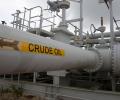
There is positive correlation between crude oil prices and Indian equities and investors can expect more upside after the recent rally in Brent crude price.

Dalal Street investors became richer by Rs 9.68 lakh crore in five days of market rally, where the Sensex breached the historic 73,000-mark for the first time ever to reach a new record peak, taking the market capitalisation of BSE-listed companies to an all-time high of Rs 376 lakh crore. The 30-share BSE Sensex jumped 759.49 points or 1.05 per cent to settle at a new closing high of 73,327.94 on Monday. During the day, it zoomed 833.71 points or 1.14 per cent to reach its all-time peak of 73,402.16.

The biggest bounce is in the realty sector, where the industry index jumped 80%. There's been a turnaround also in automobiles and ancillaries (up 45%). The pharma and health care indices have a welcome return of roughly 35%.

Nestle, Infosys, ICICI Bank, Tata Motors, Tata Consultancy Services, HCL Technologies, Tech Mahindra and Axis Bank were the other major winners. Sun Pharma, Asian Paints, Bajaj Finance and Titan were the laggards.
Benchmark stock indices Sensex and Nifty cut short their four-day gaining streak to close lower by half a per cent on Wednesday due to profit-taking in banking oil and metal stocks amid weak trends in global markets.
